
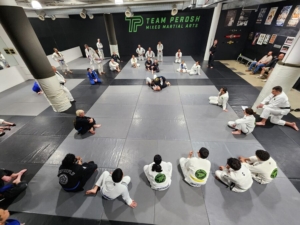
From Warm-Ups To Rolling: What Actually Happens During BJJ Training?
Thinking about trying Brazilian Jiu-Jitsu but aren’t quite sure what you’ll be walking into? You’re not alone. Terms like drilling, guard, submissions and rolling can make BJJ sound complicated when you’re completely new to the sport.
So, what is BJJ training actually like? While every class can be a little different, training generally takes you through a structured progression from warming up and learning techniques to practising with a partner and eventually testing your skills against resistance. Here’s what you can expect when you step onto the mats.
What is BJJ training?
Brazilian Jiu-Jitsu is a grappling-based martial art that focuses largely on controlling an opponent through positioning, leverage and technique. During training, you’ll learn skills such as escapes, sweeps, guard passes, transitions and submissions.
But a BJJ class isn’t simply an hour of fighting. New skills are generally introduced through instruction and controlled practice before students have opportunities to apply what they’ve learned against resistance. This combination of learning, repetition and live practice helps students gradually turn individual techniques into a more complete understanding of BJJ.
1. Warming up and getting ready to move
Training will often begin by preparing your body for the session ahead. Depending on the class, your warm-up might include light cardio, mobility exercises, partner drills or BJJ-specific movements.
Don’t be surprised if you encounter unfamiliar movements such as hip escapes, commonly known as “shrimping” or bridges. These exercises get your heart rate up with movement patterns that can also form part of techniques you’ll encounter on the mats.
2. Learning the technique
Next comes instruction. Your coach may introduce a particular position or demonstrate a technique such as an escape, sweep, guard pass, transition or submission. Rather than simply showing the finished movement, your coach will typically break it down into individual steps and explain important details such as positioning, grips, weight distribution and timing.
There’s plenty to take in when you’re starting out, so don’t expect yourself to remember every detail after seeing a technique once. Watch carefully, ask questions when needed and focus on understanding the key movements.
3. Drilling with a partner
Now it’s time to turn what you’ve seen into something you can actually do.
Students typically pair up and take turns practising the demonstrated technique. Your partner provides a controlled situation in which you can repeat the movement and focus on getting the details right.
Drilling gives you the opportunity to make adjustments, receive feedback and build familiarity before greater resistance is introduced. Rather than worrying about “winning”, concentrate on performing the technique correctly and understanding why it works.
4. Testing your skills with positional training
Some sessions also include positional training, which bridges the gap between drilling and unrestricted rolling. Instead of starting from anywhere, you and your partner begin in a particular position with specific objectives. For example, one student might try to pass the guard while the other attempts to retain it or sweep.
Because your partner is now resisting, you have to make decisions and adapt rather than simply repeat a predetermined sequence. It’s a valuable opportunity to discover which parts of a technique you understand and which still need work.
5. Rolling: putting your BJJ into practice
“Rolling” is the BJJ term for live sparring. Unlike drilling, your partner is actively trying to apply their own techniques while preventing you from applying yours.
During a roll, you’ll move between positions while looking for opportunities to control, escape, sweep or submit. If you’re caught in a submission, tapping signals your partner to stop and allows you both to reset safely.
See what BJJ training is like in person
You don’t need to arrive knowing the terminology or already be an expert grappler. Listen to your coaches, ask questions and give yourself time to become comfortable with unfamiliar movements and positions.
Ready to experience it firsthand? Train and master BJJ in Sydney at Team Perosh and discover structured, coach-led BJJ for beginners through to experienced practitioners.
 Follow